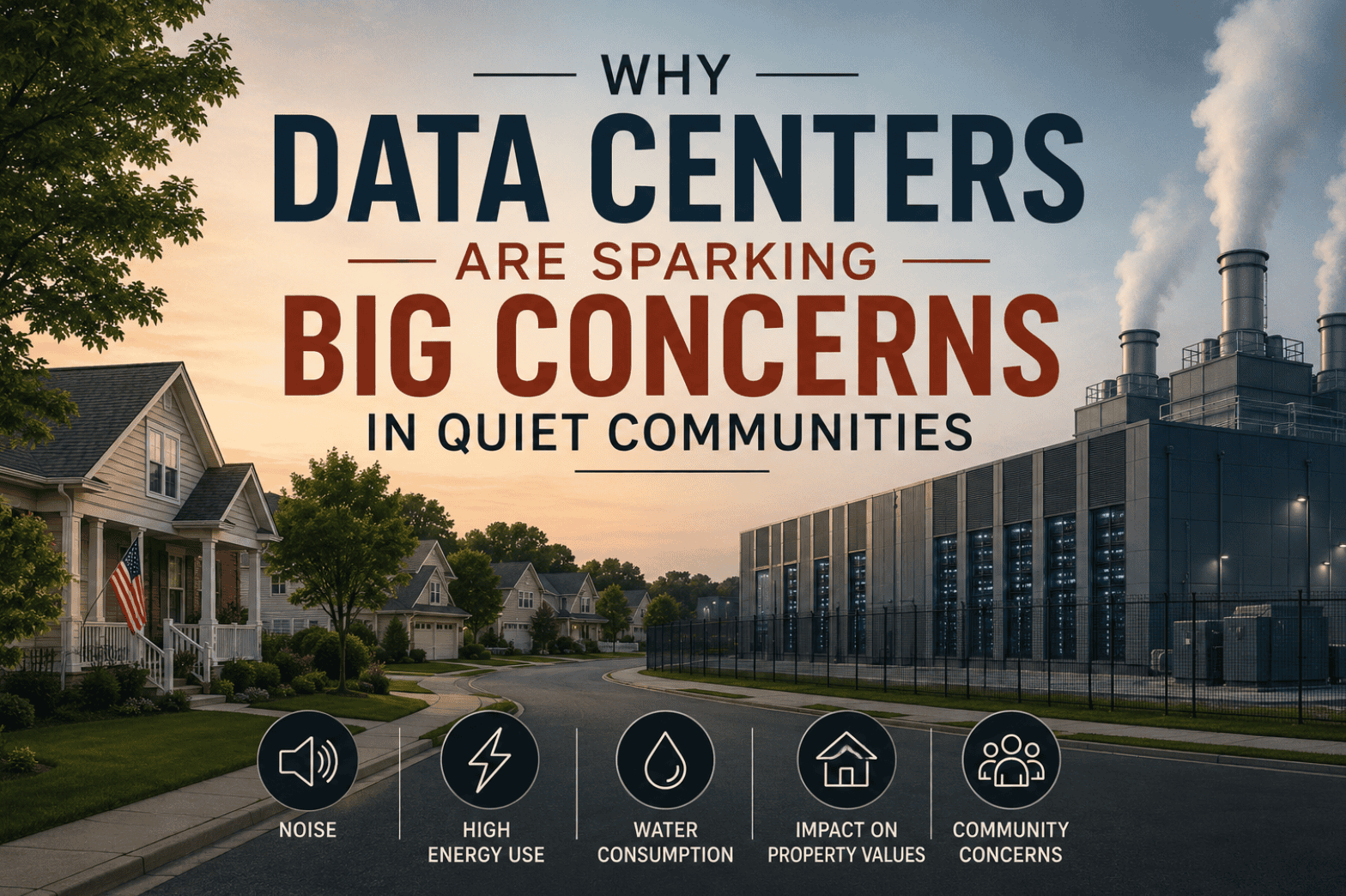
The Invisible Neighbors: Why Data Centers Are Sparking Big Concerns in Quiet Communities
If you have been keeping an eye on the news lately, you have probably noticed a growing, passionate conversation surrounding data centers. Once tucked away quietly in major tech hubs, these massive facilities are rapidly spreading across the country, frequently cropping up in rural spaces, small towns, and suburban communities.
While the internet feels completely weightless, the physical infrastructure keeping it alive is massive. As these industrial complexes become our new neighbors, many people are asking exactly what they are, and why they are suddenly causing so much friction.
What Exactly is a Data Center?
It is easy to think of the internet as floating in an invisible “cloud.” In reality, every single time you look at an online map, stream a video, back up personal photos, check an email, or ask an AI tool a question, that information travels directly to a physical location.
That location is a data center.
Essentially, a data center is a massive warehouse, often spanning hundreds of acres, packed from floor to ceiling with thousands of high-powered computers called servers. Because these computers run 24 hours a day, 7 days a week, they generate an incredible amount of intense heat. To keep them from overheating and failing, they must be continuously cooled by industrial-scale HVAC systems and large water chillers.
Why the Sudden Outcry?
We have relied on data centers for decades, but the recent Artificial Intelligence (AI) boom has completely shifted the scale. Processing an AI query requires astronomically more power than a traditional search engine request. To keep up with this demand, technology companies are racing to build “hyperscale” data centers at a record pace.
This rapid footprint is creating real-world friction in several key areas:
1. Straining the Electric Grid and Raising Utility Bills
Data centers are absolute energy hogs. Recent projections suggest that U.S. data centers could consume up to 12% of the nation’s entire electricity demand by 2028 (Halloran, 2026; Rising, 2026). Because our existing electrical grid was not built to handle such massive, sudden spikes in demand, some power companies are delaying the retirement of old fossil-fuel plants or building new natural gas lines to keep pace. Furthermore, when utilities upgrade their infrastructure, those massive construction costs have historically been passed down to everyday ratepayers, causing residential electric bills to climb in high-density tech corridors.
2. Massive Local Water Consumption
To keep servers from melting down, many facilities rely on evaporative cooling. A single, medium-sized data center can consume between 3 million and 5 million gallons of water every single day, roughly the same amount used by an entire small town. Because this water is evaporated into the air to cool the machinery, it is entirely consumed and not returned to the local watershed, threatening water security in drought-prone areas.
3. Local Air and Noise Pollution
For people living near these complexes, quality of life can change dramatically. The constant running of industrial cooling fans creates a permanent, low-frequency hum that can disrupt the peace of nearby homes. Additionally, data centers keep massive banks of diesel backup generators on-site to protect against power outages; testing and running these generators releases nitrogen oxides and fine particulate matter directly into the local air supply.
4. Swallowing Up Rural Spaces
Because these complexes require massive acreage, developers are increasingly targeting rural communities where land is less expensive and zoning laws are flexible. This rapid industrialization of agricultural areas has caught many quiet communities off guard, leading to sharp debates over land preservation.
What Can Concerned People Do?
If you are worried about the impact data centers might have on your energy bills, water systems, or local landscape, you do not have to just sit back and watch it happen. There are several highly effective ways citizens can advocate for responsible, transparent growth:
- Attend Local Planning and Zoning Meetings: Data centers cannot be built without local government approval. Attending county commissioner or zoning board meetings is the single best way to voice concerns before blueprints are finalized. You can advocate for strict boundaries, requiring data centers to be built only in heavily industrialized areas rather than near neighborhoods or pristine farmland.
- Advocate for “Ratepayer Protection” Policies: Reach out to your state representatives and public utility commissions. Demand policies that protect residential consumers from paying for the massive grid upgrades required by multi-billion-dollar tech corporations. Many communities are successfully pushing for laws that force tech companies to fund 100% of their own power infrastructure.
- Demand Environmental Transparency: Push for local ordinances that require data center developers to disclose exactly how much water and energy they intend to use before they are granted a building permit. Citizens can demand that developers use advanced “closed-loop” or waterless air-cooling systems rather than pulling from shared community aquifers.
- Support Clean Energy Requirements: Encourage local and state leaders to mandate that new data centers bring their own new, clean energy sources (like dedicated solar or nuclear partnerships) to the grid, rather than pulling from existing power supplies or forcing old coal and gas plants to stay online.
Technology is an undeniable part of our modern lives, but a growing community movement is proving that digital progress does not have to come at the expense of our local resources and peace of mind.
References
Enriquez-Contreras, L. (2026). Bridging the gap for powering data centers. Idaho National Laboratory. https://inl.gov/content/uploads/2026/01/Bridging-the-Gap-for-Powering-Data-Centers.pdf
Halloran, C. (2026). Grid impact of reservoir thermal energy storage for data center cooling. Stanford University. https://pangea.stanford.edu/ERE/db/GeoConf/papers/SGW/2026/Halloran.pdf
Kay, O. (2026). Processing power: The effect of data centers on wholesale electricity markets. Federal Reserve Bank of Dallas. https://www.dallasfed.org/~/media/documents/research/papers/2026/wp2606.pdf
Cited by: 3
Muller, N. Z. (2026). Measuring the impact of data centers in the United States economy: Monetary damage from air pollution. National Bureau of Economic Research. https://www.nber.org/system/files/working_papers/w35100/w35100.pdf
Cited by: 3
Privette, A. P. (2026). Data center expansion in Virginia: Closing critical gaps for informed water planning and permitting. Illinois Secure Water. https://securewater.illinois.edu/data-center-expansion-in-virginia-closing-critical-gaps-for-informed-water-planning-and-permitting/
Cited by: 1
Rising, H. C. E. C. M. (2026). Data center power play. Union of Concerned Scientists. https://www.ucs.org/sites/default/files/2026-01/Data-Center-Power-Play-report-final.pdf
Rogers, M. M., Ota, W. M., Burola, N., & Piquado, T. (2026). The infrastructure equation: Water, energy, and community policy for Georgia’s data center boom. arXiv. https://arxiv.org/pdf/2602.10526
Cited by: 1
Verma, S. (2026). A call to address the generative AI-environment paradox in graduate medical education. PMC. https://pmc.ncbi.nlm.nih.gov/articles/PMC13086153/
Cited by: 1







Thank you for the great explanation regarding Data Centers. We live in a rural community with a lot of agriculture and hate the thought of losing all that fertile ground. I wish they could use the land where vacant factories sit idle. I live in Michigan, so we have plenty.
It’s really becoming a problem, and worrisome because of the water it uses! I agree about reusing the old sites. That’s brilliant!