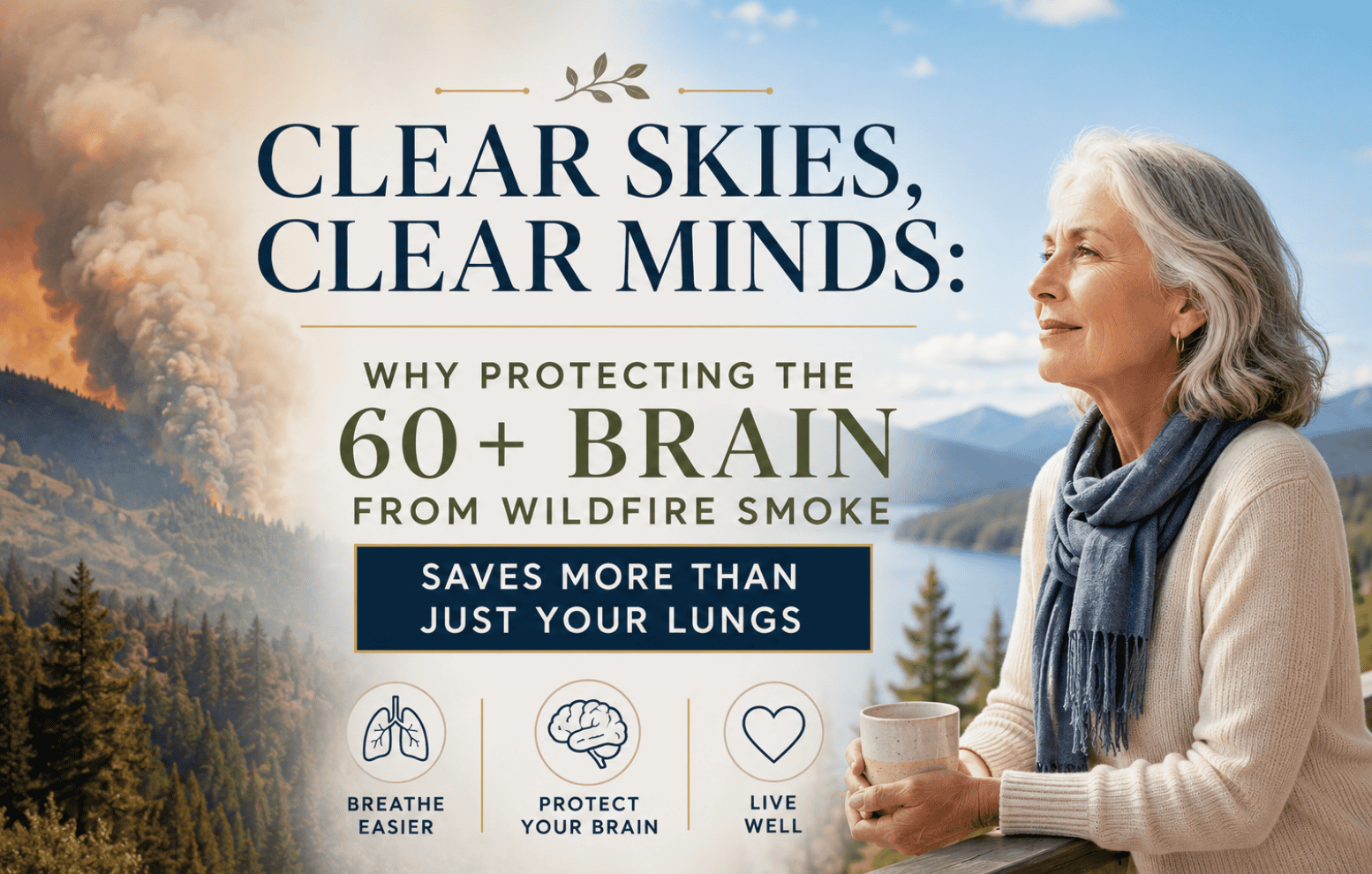
Clear Skies, Clear Minds: Why Protecting the 60+ Brain from Wildfire Smoke Saves More Than Just Your Lungs

If you’ve stepped outside or looked through your window lately, you’ve likely noticed the hazy, yellow-hued skies. With hundreds of wildfires currently burning across Canada and the U.S. Great Lakes region, air quality alerts have become a regular fixture of our summer forecasts.
For those of us over 60, the standard advice during these alerts is familiar: Stay indoors to protect your lungs and heart. But groundbreaking medical research reveals an even more compelling reason to stay inside and keep your air clean.
It turns out that breathing in wildfire smoke isn’t just a threat to your respiratory system—it poses a direct threat to brain health and memory longevity.
- Joyful, Simple, and Clean: The Ultimate Guide to Solo Dining
- Staying Safe and Healthy: What You Need to Know About the Summer Cyclospora Surge
The Hidden Connection: Air Quality and Dementia
For years, scientists have known that long-term exposure to general air pollution raises the risk of cognitive decline. However, a major recent study presented at the Alzheimer’s Association International Conference uncovered a startling twist: wildfire smoke is significantly more dangerous to brain health than other forms of air pollution.
The culprit is PM2.5, fine particulate matter that is less than 2.5 micrometers in diameter (about 30 times smaller than the width of a single human hair). Because these particles are so microscopic, when we breathe them in, they don’t just stay in our lungs. They can enter our bloodstream and even travel up the olfactory nerve (the nerve responsible for our sense of smell) directly into the brain.
Once inside the brain, PM2.5 causes cellular inflammation and oxidative stress—two major drivers of Alzheimer’s disease and other forms of dementia.
The study tracked the health records of over 1.2 million older adults and found that exposure to wildfire PM2.5 was associated with a notably higher risk of receiving a new dementia diagnosis compared to everyday traffic or industrial pollution.
Why Wildfire Smoke is Different
You might wonder why smoke from a forest is worse than exhaust from a tailpipe.
When a wildfire tears through a landscape, it doesn’t just burn wood. It consumes entire homes, vehicles, plastics, industrial chemicals, and trace metals. The resulting smoke is a highly toxic chemical cocktail. Furthermore, researchers at Stanford University recently noted that breathing heavily polluted wildfire smoke for just a few days can cause as much cellular damage to the body as smoking cigarettes over that same period.
Because our brains naturally become more vulnerable to inflammation as we age, adults in their 60s, 70s, and beyond are the most susceptible to this airborne threat.
Your “Brain-Defense” Action Plan for Smoky Days
We can’t control the wildfires, but we can completely control our immediate environment. Here are the most effective ways to protect both lung and brain health when the air quality index (AQI) rises:
- Check the AQI Every Morning: Before planning your day, make it a habit to check a reliable tracker like AirNow. If the index creeps into the orange (“Unhealthy for Sensitive Groups”) or red (“Unhealthy”) zones, pivot to indoor activities.
- Create a “Clean Air Clean Room”: Pick a primary room in the house where you spend the most time (like the bedroom or living room). Keep the windows tightly sealed. Run an air conditioner on the “recirculate” setting so it isn’t pulling in smoky air from outside.
- Invest in a HEPA Filter: True HEPA (High-Efficiency Particulate Air) purifiers are the gold standard for trapping PM2.5 particles. Place one in your designated clean room.
- Upgrade Your Face Mask: If you absolutely must go outside on a hazy day, a standard surgical mask or cloth mask won’t cut it, the microscopic smoke particles pass right through them. Opt for a tightly fitted N95 or KN95 mask, which is specifically designed to filter out fine particulate matter.
- Keep Indoor Air Clean, Too: When it’s smoky outside, avoid activities that create indoor particulate pollution. Postpone frying foods on the stove, don’t light candles or incense, and avoid vacuuming (which can stir up settled dust particles into the air).
Living Well Means Breathing Well
Healthy aging is all about protecting the things that give us quality of life: our independence, our mobility, and our memories.
The next time you see a hazy sky on the morning news, don’t just think of it as a bad weather day. Think of your indoor sanctuary as a direct investment in your cognitive longevity. Stay inside, turn on the air purifier, and keep your mind as clear as you want the skies to be.
What do you think? Have you noticed the air quality affecting how you feel or breathe lately? What steps are you taking to keep your home’s air clean? Let’s chat in the comments below!






Thanks for this information. I live in MT, so we see (and smell!) wildfire smoke every summer & fall. I never thought about exposure to smoke & brain heath. As much as I love the nice, fresh morning & evening air, I keep an eye on the air quality, & close up when necessary. Good info!!
I was surprised at the dementia link! Stay safe.
Lisa how long do you think you will stay indoors? What will your day to day look like?
I’m okay to go outside. The air quality isn’t bad, yet. 🙂