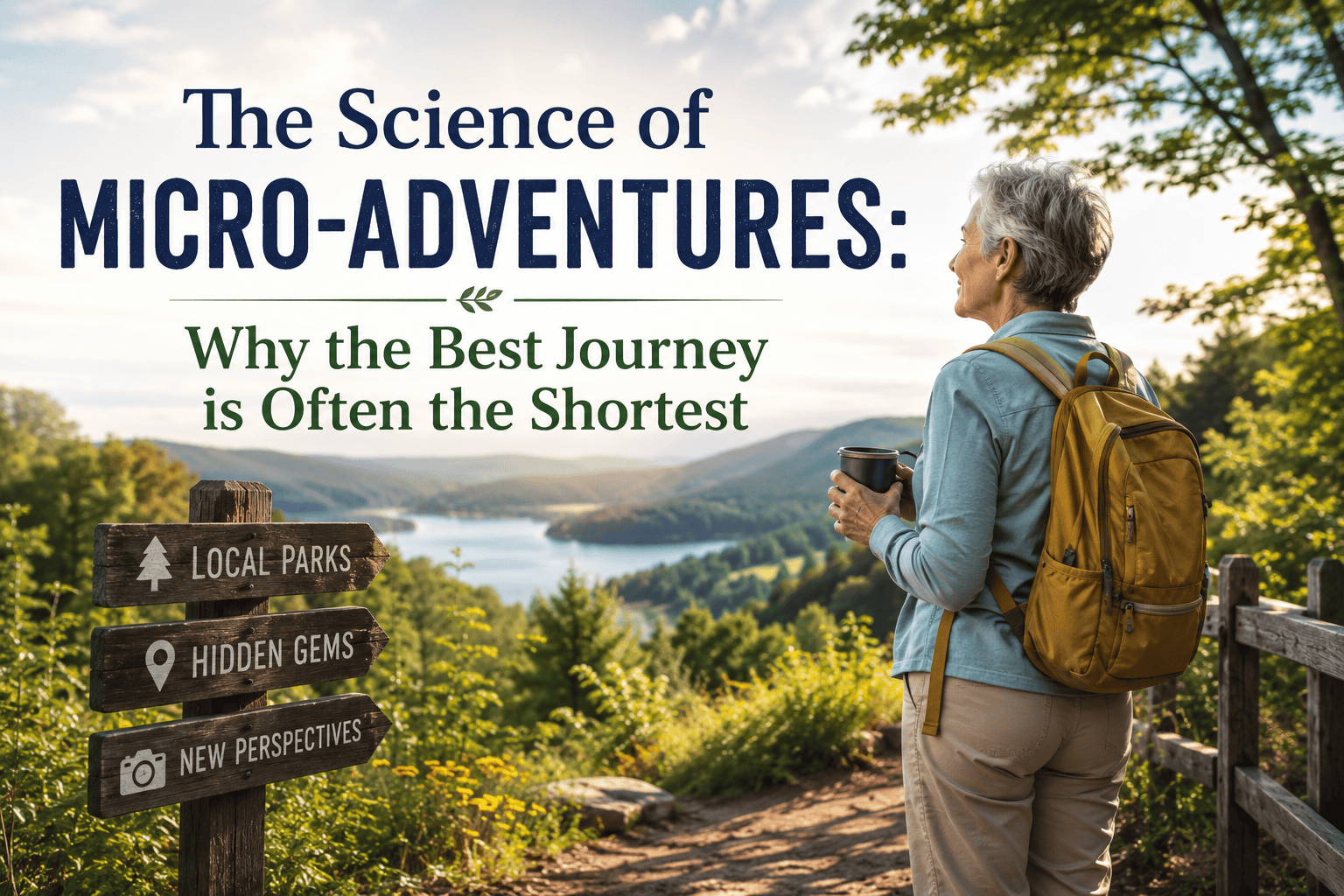
The Science of Micro-Adventures: Why the Best Journey is Often the Shortest
For years, the travel industry has sold us a specific vision of “adventure”: a grueling twelve-hour flight, a suitcase lived out of for three weeks, and a mounting credit card bill, all in pursuit of a bucket-list destination. We’ve been conditioned to believe that for an experience to be transformative, it must be distant.
But as we navigate the “Second Act” of our lives, many of us are discovering a quieter, more profound truth. Radical rejuvenation doesn’t require a passport. In fact, some of the most significant neurological and emotional benefits come not from crossing oceans, but from crossing the county line.
- Why Genealogy Is the Ultimate Brain-Boosting Hobby for Seniors
- The Brain-Boosting Power of the Tiles: Why Mahjong is the New Essential for 2026
Welcome to the world of the Micro-Adventure.
Coined by adventurer Alastair Humphreys, a micro-adventure is defined as an experience that is “short, perspective-shifting, and close to home.” For the sophisticated senior, it is the ultimate wellness tool. It’s an intentional, small-scale exploration, typically within a two-hour radius, designed to break the “autopilot” of daily life.
Today, we’re diving into the science of why these small trips pack such a massive punch for our mental and physical health.
The Neurological Spark: The Power of Novelty
Our brains are efficiency machines. When we follow the same routine, the same grocery store, the same walking path, the same view from the porch, our brains slip into “energy-saving mode.” We stop processing details because we’ve seen them a thousand times. This is why time seems to “speed up” as we age; when nothing is new, the brain doesn’t bother creating distinct memories.
Novelty is the antidote to this cognitive fog.
When you embark on a micro-adventure, perhaps visiting a small-town historical archive you’ve driven past for a decade or walking a trail in a state park you’ve never entered, your brain wakes up. This “environmental enrichment” triggers the release of dopamine, the chemical associated with reward and motivation, and norepinephrine, which sharpens our focus.
Science shows that exposing ourselves to new environments, even small ones, promotes neuroplasticity. By navigating a new path or learning the history of a local landmark, you are literally forging new neural connections. You aren’t just “killing time”; you are exercising your brain’s ability to adapt and grow.
The Sensory Reset: Soft Fascination and “Awe”
One of the greatest benefits of a micro-adventure is the shift from “Directed Attention” to “Soft Fascination.”
In our daily lives, we use Directed Attention to handle tasks: paying bills, responding to emails, or navigating traffic. This type of focus is exhausting and leads to mental fatigue. However, when you step into a hidden botanical garden or sit by a local creek, you experience Soft Fascination. This is a state where your attention is held by the environment, the pattern of light through leaves, the sound of water, the scent of pine, without any effort.
Psychologists call this Attention Restoration Theory (ART). It’s the mental equivalent of hitting the “reset” button. Studies have shown that even twenty minutes in a natural setting can significantly lower cortisol levels (the stress hormone) and improve short-term memory.
Furthermore, micro-adventures provide a low-stakes way to experience Awe. We often think awe is reserved for the Grand Canyon, but it can be found in the intricate stonework of a 19th-century local courthouse or the sheer scale of an 80-acre wooded property. Awe has been shown to reduce inflammation in the body and increase our feelings of connection to others. It reminds us that we are part of something larger, which is a powerful buffer against the isolation sometimes felt in retirement.
The “Awe” Effect
Awe has been shown to reduce inflammation in the body and increase our feelings of connection to others.
Accessible Physicality: Movement Without the “Workout”
We all know we need to stay active, but the word “exercise” often feels like a chore. Micro-adventures reframe physical activity as exploration.
When you decide to visit a local state park to see a waterfall, you aren’t “going for a walk”; you’re on a mission. This psychological shift makes movement feel effortless. Walking on uneven terrain—like a forest path or a gravel road—engages smaller stabilizer muscles and improves balance, which is vital for long-term mobility.
The beauty of the micro-adventure is its accessibility. You don’t need specialized gear or peak athletic conditioning. You can choose a destination that fits your energy level for that specific day. Some days, it’s a two-mile hike; other days, it’s a slow stroll through a local gallery. Both count. Both move the needle on your physical health.
Three “Micro-Adventure” Archetypes to Try This Week
If you’re ready to start your own “short-range” expedition, here are three directions to point your car:
1. The Historical Deep-Dive
Every town has a story that is overlooked by the people who live there. Visit a local historical society, a small-town museum, or a pioneer cemetery.
- The Science: This engages your “crystalized intelligence”, your ability to use learned knowledge and experience. It connects your personal timeline to the timeline of your community, fostering a sense of place and belonging.
2. The Botanical “Slow-Down”
Find a public garden, an arboretum, or even a high-end nursery that specializes in native plants.
- The Science: This is a sensory feast. Focus on the “fractals”, the repeating patterns in nature (like the veins in a leaf or the petals of a flower). Humans are evolutionarily hardwired to find these patterns relaxing.
3. The “New Eyes” Transit
Choose a town within 45 minutes of your home that you usually only drive through. Park the car and walk the main street as if you were a tourist from another country. Eat at the local diner, browse the hardware store, and talk to the shopkeeper.
- The Science: This encourages Social Novelty. Brief, “weak-tie” social interactions, like chatting with a stranger, have been shown to boost mood and decrease feelings of loneliness just as much as deep conversations with friends.
Overcoming the “Proximity Paradox”
The biggest hurdle to micro-adventuring is what I call the Proximity Paradox: the belief that because something is close, it isn’t special. We tell ourselves, “I can go there anytime,” and as a result, we never go at all.
To combat this, you must treat your micro-adventure with the same respect you would give a trip to Europe.
- Mark it on the calendar.
- Pack a “Go-Bag” with water, binoculars, a field guide, and a camera.
- Silence your phone.
When you treat your local surroundings with reverence, they begin to reveal their secrets. You’ll start to notice the way the light hits the ridges of the hills at 4:00 PM, or the specific species of birds that frequent your local woods.
The Harvest of the Local
Micro-adventures allow us to be explorers without the exhaustion. They remind us that “adventure” is a state of mind, not a line on a map.
This week, I challenge you to look at a map of your own county. Find one green space, one blue line of water, or one historical dot you’ve never visited. Drive there. Breathe the air. Look with fresh eyes.
Your brain, your body, and your spirit will thank you for the trip.
Source: How Does Emotion Influence Time Perception