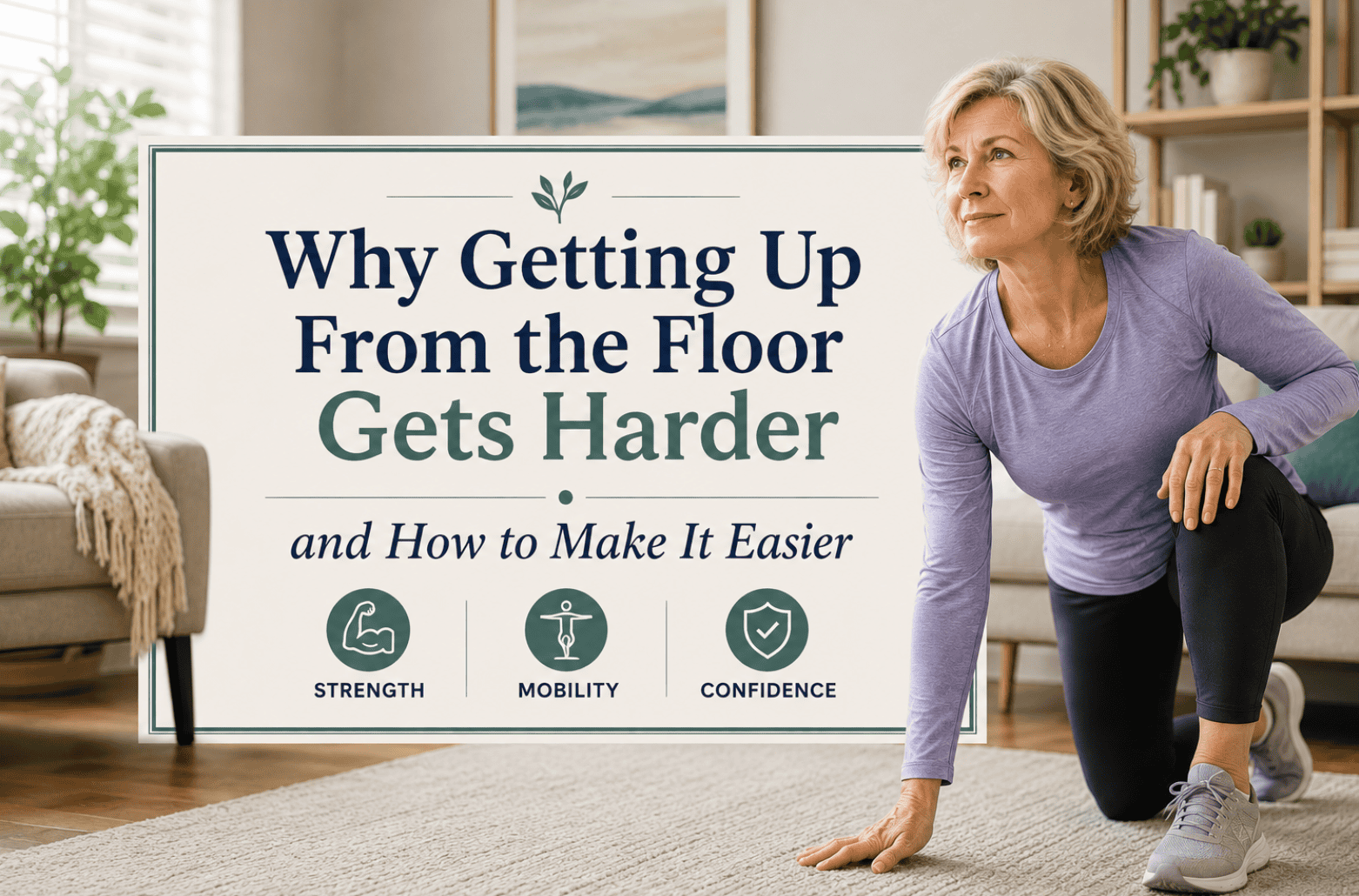
Why Getting Up From the Floor Gets Harder and How to Make It Easier
There’s a moment many adults 60+ know well: you drop something, kneel down to pick it up, and suddenly getting back to your feet takes real effort, maybe even a hand on the nearest chair. It can feel like it happened overnight. In reality, it’s the result of several gradual changes working together, and understanding them is the first step toward making that motion easier again.
- Why Shared Hobbies Are the Shortcut to Adult Friendships After 60
- The Signs of a Stroke Everyone Should Know (And What to Do Immediately)
What Changes as We Age
Muscle strength declines. Starting around age 30, adults lose a small percentage of muscle mass each decade, a process called sarcopenia. It accelerates with age, particularly in the legs, hips, and core, which happen to be the exact muscle groups needed to push yourself up off the ground.
Joints get stiffer. Cartilage naturally thins over time, and the fluid that keeps joints moving smoothly can decrease. The knees and hips, which do most of the work in a floor-to-standing transition, often feel this first.
Balance and coordination shift. The inner ear, vision, and the nerves that sense body position all play a role in balance, and each can become less precise with age. That’s part of why getting up from the floor can feel less stable than it used to, even when strength isn’t the main issue.
Bone density decreases. Lower bone density doesn’t directly make standing up harder, but it raises the stakes, it’s part of why a fall or an awkward movement carries more risk than it once did, which can make people move more cautiously.
The good news: none of this means getting up from the floor has to stay difficult. Strength, balance, and mobility all respond well to consistent, gentle practice.
Easier Ways to Get Up From the Floor
Instead of trying to stand straight up from a seated position, try breaking the movement into stages:
- Roll to your side. From sitting or lying down, roll onto one side rather than trying to sit straight up.
- Come up onto hands and knees. Push through your side to get into a hands-and-knees position.
- Move into a half-kneel. Bring one foot flat on the floor in front of you, so you’re in a half-kneeling lunge position.
- Press up to standing. Push through the front foot and use a nearby sturdy surface, a chair seat, a low table, for support as you rise.
Breaking the movement into smaller steps distributes the effort across multiple muscle groups instead of asking the knees or lower back to do all the work at once.
Building the Strength and Balance That Make It Easier
A few simple, low-impact habits can make a real difference over time:
- Sit-to-stands. Practicing rising from a sturdy chair without using your hands (or using them only lightly) builds exactly the leg strength this movement requires.
- Wall or chair-supported squats. These strengthen the hips and thighs while offering built-in support.
- Gentle stretching for hips and knees. Improved flexibility makes the half-kneeling position more comfortable.
- Balance practice. Simply standing on one foot near a countertop for a few seconds at a time, done regularly, meaningfully improves stability.
A Few Comfort Considerations
The right clothing can make floor-based movement feel less intimidating. Fabric that moves with you, rather than restricting a hip hinge or a knee bend, makes practicing these transitions far more comfortable. Look for activewear with a bit of stretch and a comfortable, non-binding waistband, so the focus stays on the movement itself rather than fighting your clothes.
The Bottom Line
Getting up from the floor with ease isn’t about turning back the clock; it’s about practicing a movement pattern the body may have simply stopped using regularly. With a little consistent practice, most people find it gets noticeably easier within a few weeks.






All great suggestions for moving.
Thank you!😊
Thank you for the helpful information.
I do stretching exercises And yoga as well as lift weights. My husband and I are in our mid 70s and we say it’s important to keep our balance and strength so we can stay independent. I always say it’s move it or lose it.
Beth, that is so true! I sit a ton because of my computer work, but I hope to play tennis and pickleball as long as I can. And I have a kettlebell beside me that I lift now and then. Thanks for commenting. 🙂