Why the Grandkids Should Learn Bridge and Why You Should Be the One to Teach Them

Screen time battles, a shrinking attention span, and grandkids who’d rather text than talk, every family knows the list. One of the best answers to all of it is sitting in a kitchen drawer: a deck of cards and a bridge scorepad.
Bridge has long been thought of as a game for the 60+ set. That reputation undersells it. The same qualities that keep bridge players sharp for decades make it one of the best things a young mind can learn. And the people best positioned to pass it on are the ones who already know how to play.
- 10 Trending Goodreads Books Released This September (You Can Read Right Now!)
- Why Shared Hobbies Are the Shortcut to Adult Friendships After 60
It’s a Math Class Disguised as a Card Game
Bridge runs on numbers. Players count high-card points to size up a hand, track how many cards in each suit have been played, and work out the odds of where the missing ace might be. None of it feels like homework. It’s just what you do to win.
For a child who groans at word problems, that’s a quiet revelation. Adding up points, keeping 13 cards in mind at once, and figuring out what’s left in a suit are real arithmetic and probability skills, practiced for fun.
It Builds Memory and Focus
A good bridge hand asks for sustained attention. Which cards have fallen? What did your partner bid, and what does that tell you? Who is likely holding the queen of spades?
That kind of steady concentration is exactly what’s hard to come by in a world of 15-second videos. Bridge gives kids a reason to hold a thought for 10 minutes, and rewards them when they do.
It Teaches Kids to Read People (Politely)
Bridge is a game of inference. Players draw conclusions from what others bid and play, and they learn to think about the whole table, not just their own hand. That’s a skill with a long shelf life, from the classroom to a future job interview.
It’s a Partnership, Not a Solo Act
Unlike most card games, bridge is played in teams of two. You win or lose together. Kids learn to trust a partner, communicate within the rules, and, perhaps most valuable of all, handle it gracefully when a partner makes a mistake.
It’s also a gentle lesson in sportsmanship. Every hand is a fresh start, and a bad deal is nobody’s fault.
Some Very Smart People Swear By It
Warren Buffett and Bill Gates are longtime bridge partners, and the two believed in the game enough to put up $1 million in the mid-2000s to fund a program teaching bridge to junior high students across the U.S. When two of the most analytical minds in business want kids at the card table, that’s worth noting.
It’s a Game You’ll Share for Life
Here’s the part that matters most. Most games kids play, they outgrow. Bridge is one they grow into, and one they can play with you at 10, at 25, and at 40.
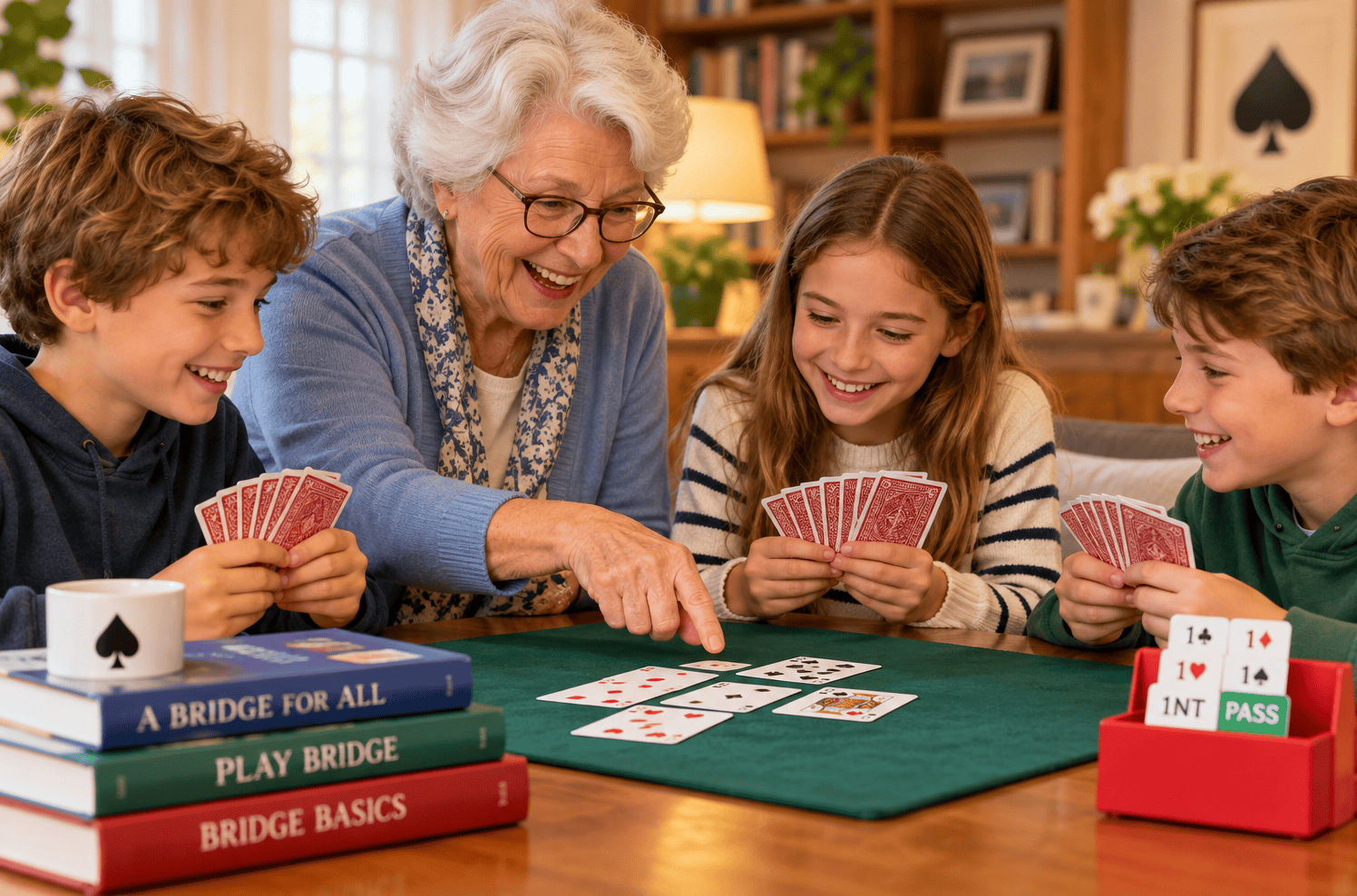
A standing Sunday game with a grandchild becomes a ritual. It’s a reason to sit across a table, face to face, for an hour at a time. Many lifelong bridge players trace their start to a grandparent who took the time to teach them. You could be that person.
Not Ready for Bridge Yet? Start Here
Younger grandkids don’t have to wait. These simpler games each teach one piece of bridge, so by the time a child is ready for the real thing, much of it will already feel familiar.
Crazy Eights — for the youngest players. Players match the top card on the pile by suit or number, and eights are wild. It’s simple enough for early elementary kids, and it teaches the habit that matters most in bridge: paying attention to suits.
Hearts — to learn how tricks work. Each player lays down one card, and the highest card of the suit that was led wins the trick. Players have to follow suit when they can. That is the heart of bridge play, and Hearts teaches it without any bidding.
Spades — to learn bidding and partnership. Spades is the closest cousin to bridge. It’s played in partnerships, spades are always trump, and each team bids how many tricks it expects to take. Kids who enjoy Spades are usually ready for bridge.
Up and Down the River — to learn how to judge a hand. Players bid exactly how many tricks they’ll take, and they score only if they hit the number right on the nose. The number of cards dealt changes each round, which keeps the game lively and teaches kids to size up a hand. That skill is exactly what bridge bidding requires. (The game also goes by several other names.)
How to Get Started
Pick the right age. Many youth programs begin around fourth grade, when kids are comfortable with addition and can hold a full hand of cards. Younger children can start with the stepping-stone games above.
Skip the bidding at first. Bidding is the hardest part of bridge, and it’s where beginners get discouraged. Simplified versions like mini-bridge let kids jump straight into playing hands and winning tricks. Once the play makes sense, bidding follows naturally.
Keep it short and fun. A few hands at a time beats a two-hour lesson. Stop while they still want more.
Play with open hands. Laying all four hands face up for the first few rounds lets you talk through each decision out loud. It turns every hand into a lesson without feeling like one.
Get the right supplies. A couple of large-print playing card decks make cards easier to hold and read for everyone at the table. A bridge scorepad and a card holder for small hands help too.
Lean on a good book. Titles written specifically for young learners, like Bridge Is for Kids by Patty Tucker and Teach Your Child Bridge by Ron Klinger, break the game into kid-sized steps.
Look for a free class. The ACBL Educational Foundation’s BridgeWhiz program offers free online beginner bridge classes for students in grades 4 through 12. It’s a smart option for grandkids who live in another state. They can learn online, then play with you on the next visit.
Practice between visits. Online bridge apps let kids play practice hands anytime, and some let family members play together from different cities.
The Bottom Line
Bridge teaches math without a worksheet, focus without a lecture, and teamwork without a coach. But the real payoff is the time at the table. Teach a grandchild bridge, and you’ve given them a lifelong skill, and yourself a lifelong partner.
Looking for more ways to keep your own mind sharp? Play one of our many games!